Praise for the previous
edition of the Encyclopedia of Translation Studies: 'Translation has
long deserved this sort of treatment. Appropriate for any college or
university library supporting a program in linguistics, this is vital in
those institutions that train students to become translators.' – Rettig
on Reference 'Congratulations should be given to Mona Baker for
undertaking such a mammoth task and...successfully pulling it off. It
will certainly be an essential reference book and starting point for
anyone interested in translation studies.' – ITI Bulletin 'This
excellent volume is to be commended for bringing together some of [its]
most recent research. It provides a series of extremely useful short
histories, quite unlike anything that can be found elsewhere. University
teachers will find it invaluable for preparing seminars and it will be
widely used by students.' – The Times Higher Education Supplement ' ... a
pioneering work of reference ...'– Perspectives on Translation The
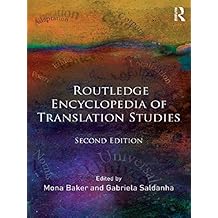
Routledge Encyclopedia of Translation Studies has been the standard
reference in the field since it first appeared in 1998. The second,
extensively revised and extended edition brings this unique resource
up-to-date and offers a thorough, critical and authoritative account of
one of the fastest growing disciplines in the humanities. The
Encyclopedia is divided into two parts and alphabetically ordered for
ease of reference. Part One (General) covers the conceptual framework
and core concerns of the discipline. Categories of entries include:
central issues in translation theory (e.g. equivalence, translatability,
unit of translation) key concepts (e.g. culture, norms, ethics,
ideology, shifts, quality) approaches to translation and interpreting
(e.g. sociological, linguistic, functionalist) types of translation
(e.g. literary, audiovisual, scientific and technical) types of
interpreting (e.g. signed language, dialogue, court). New additions in
this section include entries on globalisation, mobility, localization,
gender and sexuality, censorship, comics, advertising and retranslation,
among many others. Part Two (History and Traditions) covers the history
of translation in major linguistic and cultural communities. It is
arranged alphabetically by linguistic region. There are entries on a
wide range of languages which include Russian, French, Arabic, Japanese,
Chinese and Finnish, and regions including Brazil, Canada and India.
Many of the entries in this section are based on hitherto unpublished
research. This section includes one new entry: Southeast Asian
tradition. Drawing on the expertise of over 90 contributors from 30
countries and an international panel of consultant editors, this volume
offers a comprehensive overview of translation studies as an academic
discipline and anticipates new directions in the field. The contributors
examine various forms of translation and interpreting as they are
practised by professionals today, in addition to research topics,
theoretical issues and the history of translation in various parts of
the world. With key terms defined and discussed in context, a full
index, extensive cross-references, diagrams and a full bibliography the
Routledge Encyclopedia of Translation Studies is an invaluable reference
work for all students and teachers of translation, interpreting, and
literary and social theory. Mona Baker is Professor of Translation
Studies at the University of Manchester, UK. She is co-founder and
editorial director of St Jerome Publishing, a small press specializing
in translation studies and cross-cultural communication. Apart from
numerous papers in scholarly journals and collected volumes, she is
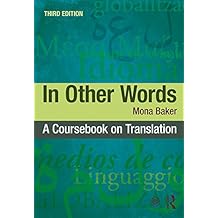
author of In Other Words: A Coursebook on Translation (Routledge 1992),
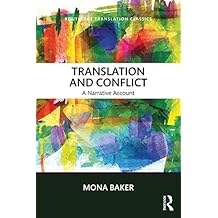
Translation and Conflict: A Narrative Account (2006) and Founding Editor
of The Translator: Studies in Intercultural Comm

Коментарі
Дописати коментар